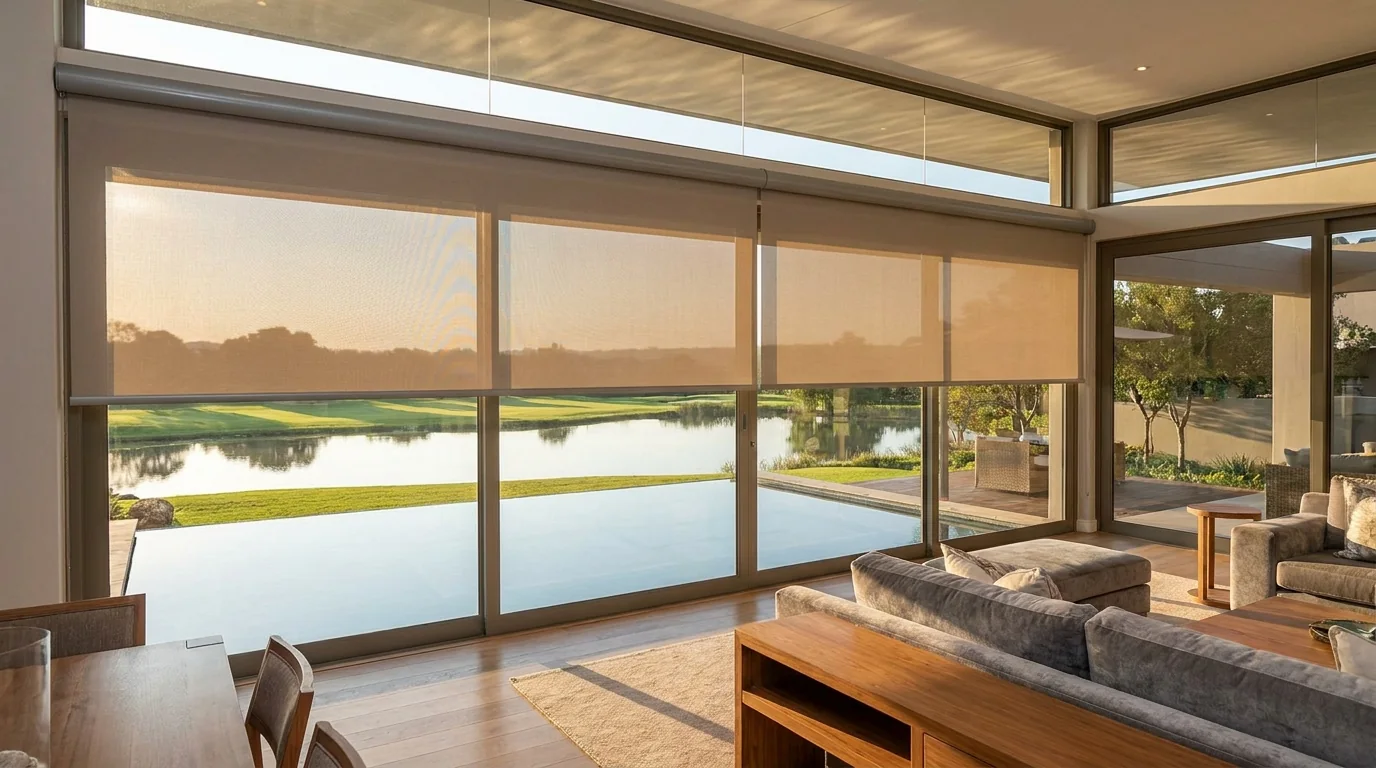
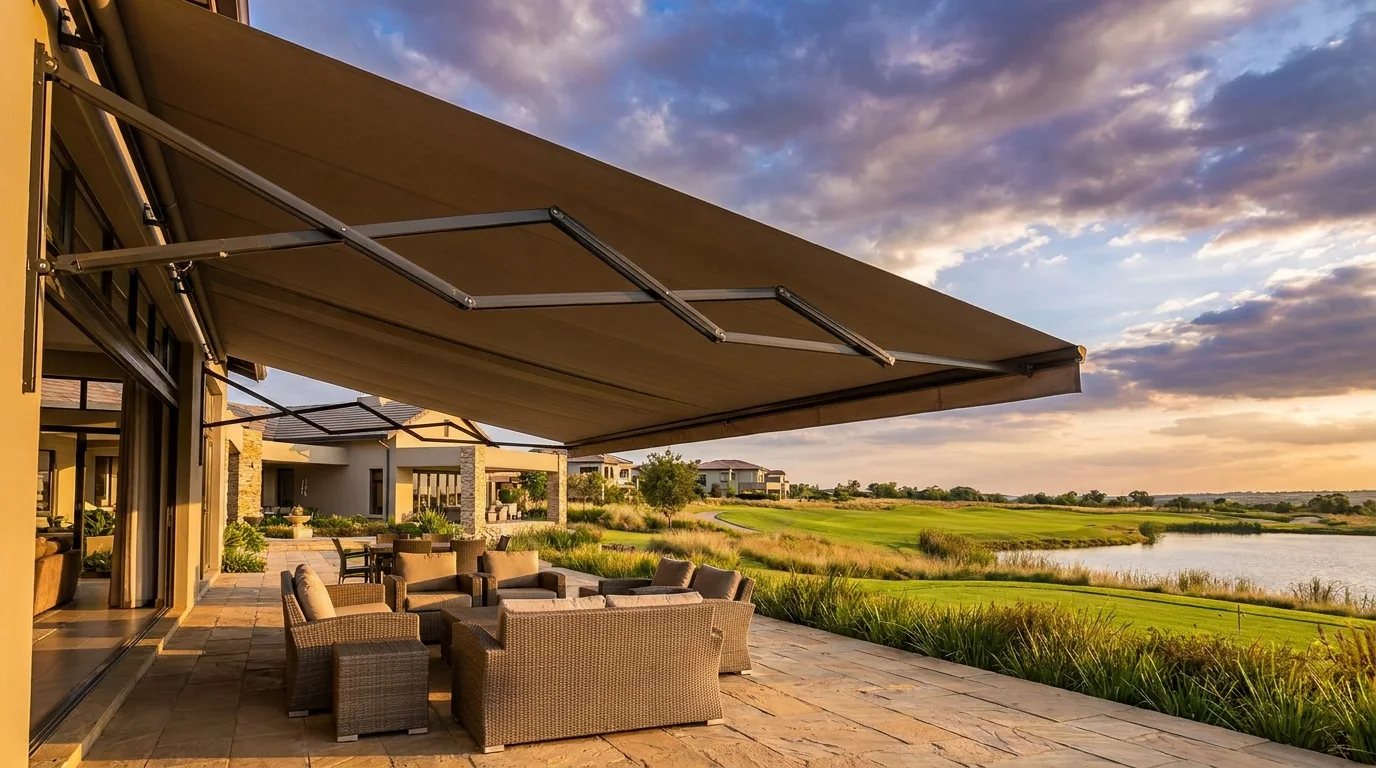
On a stand with water on one side and a fairway on the other, the light comes at you twice.
What we've worked out about sun, glare and storms on homes built around the Hennops River and the estate's dams — which wall catches it and when, what we'd put on each, and the handful of things only a tape measure on site can settle.
About a nine-minute readEvery figure sourced at the footNothing gated, nothing to fill in
Two views were the reason you bought. They're also two light problems.
Centurion Golf Estate is laid out around water as much as around its fairways. The Hennops River runs right through the 160-hectare estate, a roughly three-hectare man-made lake sits below the clubhouse, and ten of the eighteen holes bring the river and the lakes into play — so a large share of stands were positioned to look at water, grass, or both at once. That double outlook is the reason these homes get bought, and it's also two separate glare problems most suburban windows never have to answer for.
A dam or a stretch of river doesn't just sit there looking good — it reflects. A water-facing room catches bounced light off the surface on top of whatever comes through the glass directly, so the specification we'd write for it is not the one we'd write for an inland street. We treat a window here as a water-facing window first and a normal window second, and that changes the fabric openness, whether a wall gets an interior blind or exterior shading, and how seriously we take a wind sensor on anything left hanging outside.
The stock rewards that care. The estate has been built out since stands first came available in 1995, so most homes are now twenty-five to thirty years old — a large cohort at exactly the age where blinds are due for a refresh — alongside newer rebuilds and renovations, and everything from 120m² sectional-title units to full-title homes near 1,000m².
The light
Twenty-six degrees south, at altitude — a sun that climbs 47° between the solstices.
Centurion sits on the Highveld at roughly 25.9° south and about 1,400m above sea level. Both numbers land in the same specification, at opposite ends of the year — and the reflected light off the water sharpens each of them.
Midsummer: nearly overhead, then wide
At the December solstice the sun is up from about 05:13 to 18:58 and stands roughly 87° high at midday — near enough to straight overhead that flat roofs, skylights and double-volume glass take the brunt. Both ends of that long day sit well south of due east and due west, so a wall you'd assume gets no early or late sun usually does.
Midwinter: low, wide and welcome
By the June solstice the day runs only about 06:53 to 17:25 and the midday sun reaches barely 40°. With winter nights dropping to around 4–7°C, that low sun reaching deep into a north room is free heating you don't want to block permanently — you want to be able to let it back in.
The water doubles the glare
A calm dam or the river surface throws sky and sun back upward into the room, so a water-facing wall can be bright and glary even when the sun itself isn't on it — including a south wall that sees almost no direct sun. Killing that bounce, not just the direct beam, is the job an open-weave sunscreen does best.
Storms and UV decide what survives outside
Highveld thunderstorms run October to March, most frequent from mid-November, with supercells peaking October–November and hail a real Gauteng risk. The windier months are late July to November. And at altitude the UV is punishing — Pretoria's index peaks near 11.8 ("extreme") in January — which fades fabric and is a reason to stop heat outside the glass on the worst walls.
Wall by wall
Which wall is actually yours depends on how your stand faces the water
Work out which compass direction your main view wall faces, then read the matching card — on this estate the view often decided the orientation, not the street.
North
Protect it, don't block it
Gets sun most of the day. Low winter sun here is welcome warmth; high summer sun is easily shaded. You want a layer you can open again by June.
We'd fit: a sunscreen roller or external venetian you can retract — keep winter gain, lose summer heat.
West
The one with no season off
Low, direct sun every single evening, worst across summer when the sun sets in the south-west near seven. By late afternoon this is usually the room nobody can sit in.
We'd fit: stop it outside the glass — an interior blind leaves a hot pane radiating after the sun's gone.
East
An early problem, not a hot one
Summer sunrise at 05:13 lands south of due east, reaching bedrooms owners assume are shielded. A wake-too-early issue more than a heat one — the morning air is still cool.
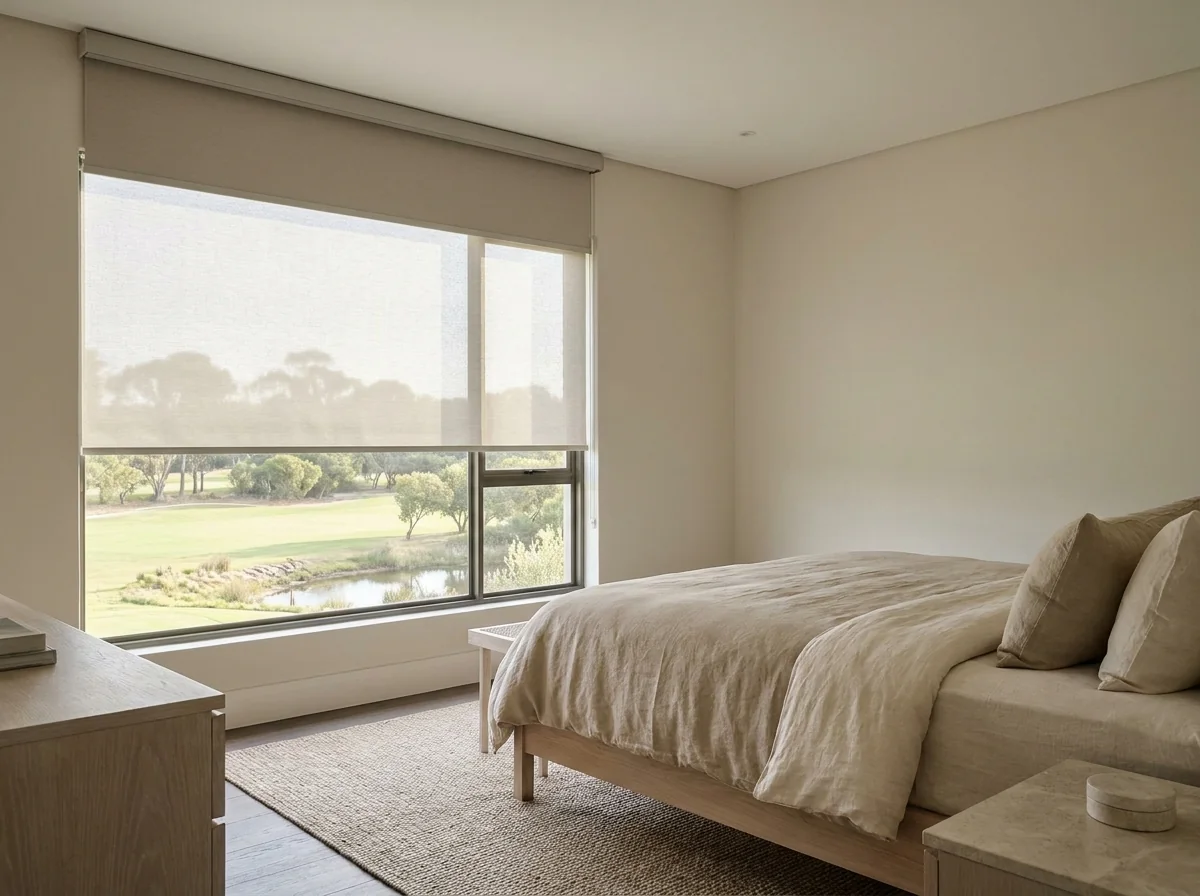
We'd fit: a blockout layer for anyone who wants to sleep past first light off the water.
South
Little direct sun, plenty bounced
Almost no direct beam at this latitude — but a south wall facing the dam or river still catches glare thrown up off the water for most of the day.
We'd fit: an open-weave sunscreen — the bounce needs killing even where the sun never lands.
What we'd fit, and why
The reasoning — and the honest catch with each
Each of these beats its obvious alternative on a particular wall, and each costs you something — the catch sits right next to the case for it. Tap Add to my window list to carry a choice down to the form at the foot of the page; nothing is ordered, it just saves you retyping.
Roller blinds — sunscreen and blockout
Best on: the water/view wall (sunscreen) · bedrooms (blockout)
Why here. A low-openness sunscreen is a single flat mesh panel on a tube — glare and that extreme summer UV drop while the dam and fairway stay readable through it, which matters when the water view is why the stand cost what it did. Blockout does the opposite job: total dark for an east bedroom catching first light at 05:13 in midsummer.
The catch. Sunscreen reverses after dark — with the lights on it shows more of the room than you'd expect, so a canal-facing lounge close to a neighbour may want blockout too. Blockout alone loses the view by day. Most water-facing bedrooms end up running both on one headrail.
External venetians & roller shutters
Best on: the west wall, and unshaded water-facing glass
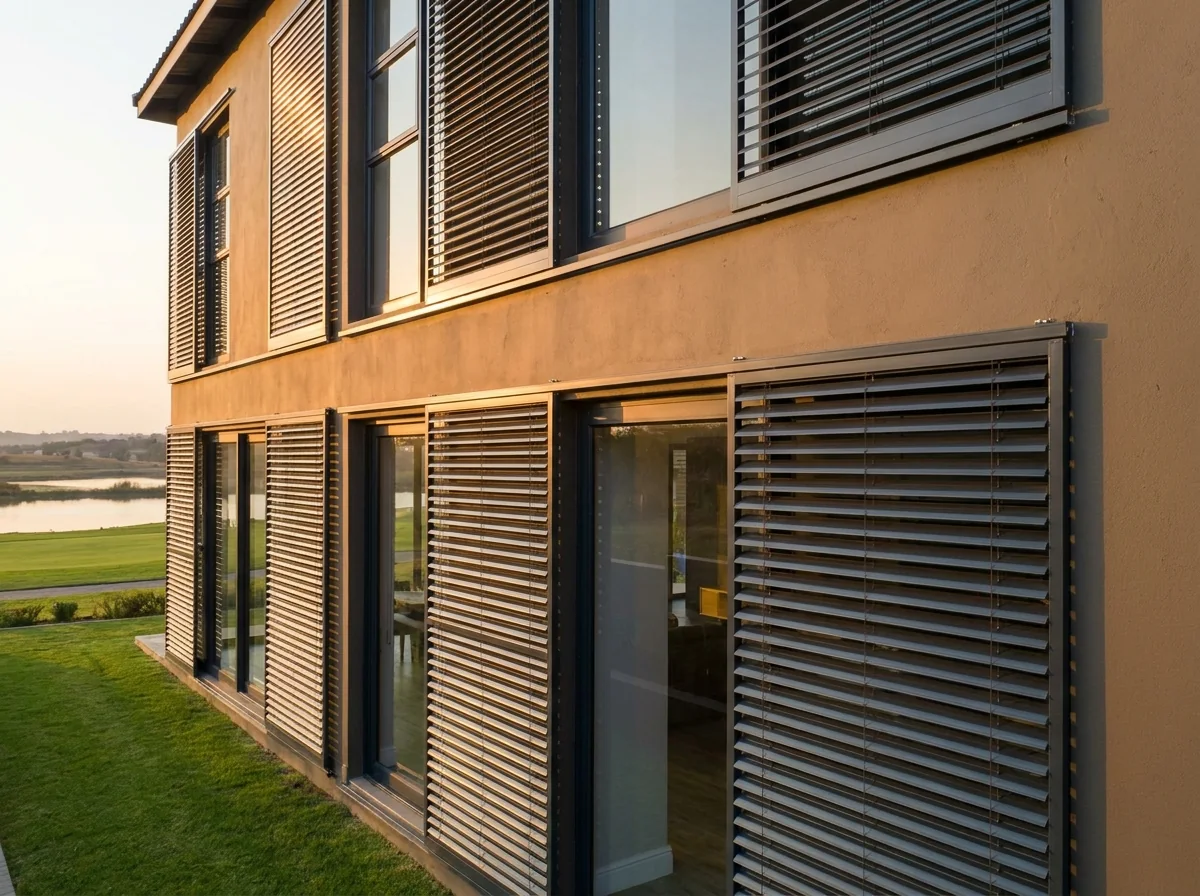
Why here. Both stop the sun outside the glass — a different result from stopping it inside. An interior blockout kills glare the instant it's down, but the pane behind it keeps radiating heat after sunset, and the west wall here catches low sun every evening of the year. External venetians tilt, so a view survives; roller shutters close flat into a compact headbox for full blackout and hail cover.
The catch. The dearest answers here, in relative terms, and both want a motor and a wind sensor through storm season. Both are exterior alterations, too — which the estate's homeowners' association has a say over (more on that below).
Shading, not security. Ours deal with sun, heat and glare, and they do it outside the glass rather than behind it. They hold no security rating — for that you would want a different product, and we are happy to quote it on request.
Day & night blinds
Best on: rooms close to a neighbour or the cart path
Why here. Alternating sheer and solid bands slide from open view to eye-level privacy without fully closing — handy on the smaller sectional-title and cluster stands, where a neighbour's window or a path sits closer than on a big freehold plot.
The catch. Never a true blockout, and the banding is a busier look than a plain roller against the estate's cleaner lines.
Aluminium & timber venetians
Best on: kitchens/bathrooms (aluminium) · studies (timber)
Why here. A tilting slat answers low sun sideways — close the angle and the beam stops while the room stays bright, which a roller's single up-down move can't do. Aluminium shrugs off a bathroom's steam and Highveld dust; timber warms a study.
The catch. Aluminium can read cold in a formal room; timber won't take a shower's steam or a kitchen splash. Pick by room, not by preference.
Cellular honeycomb blinds
Best on: the coldest rooms, and glass you won't replace
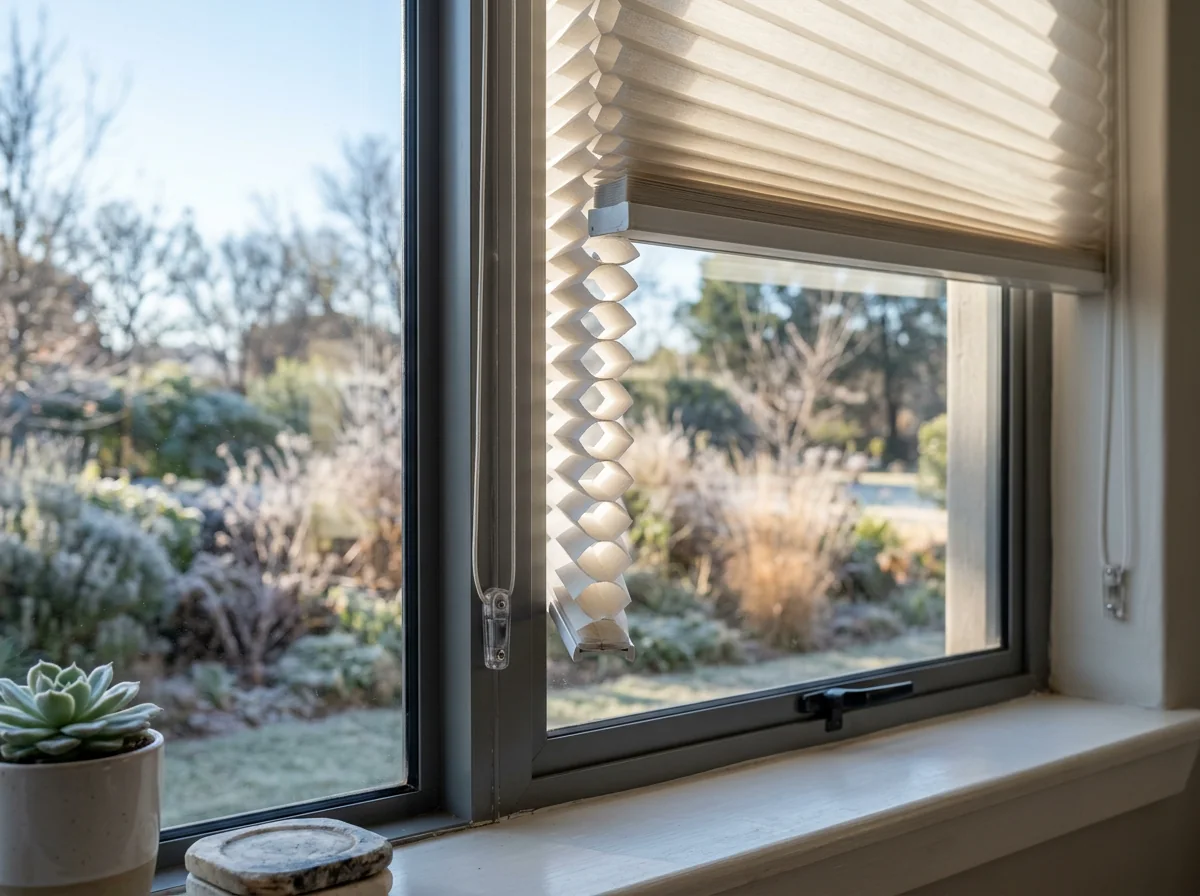
Why here. The fabric folds into honeycomb cells that trap a layer of still air against the pane — genuinely worth having with winter nights near 4–7°C, when single glazing radiates the day's heat straight back out under a clear Highveld sky. It insulates in summer's heat too.
The catch. It sits on the wrong side of the glass for the west wall's year-round low sun — against that elevation an exterior product wins. And a light-filtering cell still isn't a true blockout on its own.
Vertical & panel blinds
Best on: wide stacking and sliding doors
Why here. Vanes and sliding panels cover a three- or four-metre opening edge to edge and draw clear of the door — the practical answer for the runs of glass that open onto a water-facing patio.
The catch. Vanes sway in the draught of an open door, and a panel blind needs wall to stack onto. At a glazed corner, a wide roller often wins instead.
Concealed / recessed blinds
Best on: double-volume, architect-finish rooms
Why here. The blind drops from a slot in the ceiling line, leaving nothing to interrupt the water sightline a double-volume living room was built to show off. It vanishes until the glare needs it.
The catch. It has to be designed in before the ceiling closes — not something a finished bulkhead takes on later without work.
Folding-arm awnings
Best on: the entertaining patio over the view
Why here. Articulated arms shade the patio on demand with nothing standing on the paving, then fold flat in winter to let that low, welcome sun back onto the same spot — a fixed roof can't do both over a water view.
The catch. Wind and hail ratings are engineering limits, not marketing — an awning caught open in a storm gust won't survive it. We'd rather fit a motor and wind sensor that retracts it unattended than a manual crank someone forgets.
Zip screens
Best on: closing off a breezy water-facing patio
Why here. Wind-proof mesh runs in sealed side channels, so it holds against the breeze that funnels off open water differently to a sheltered street — turning an exposed patio into a usable room without losing the outlook.
The catch. Mesh cuts glare and insects, not full light or a determined draught at the edges — it's a shade-and-shelter screen, not a wall.
Motorisation & automation
Best on: wide water-facing glass, anything above reach
Why here. A wall of blind panels runs far easier from one remote or app than a row of chains, and outdoors it isn't a convenience — a wind sensor retracts an awning or external blind before a gust arrives, even while nobody's home. It's the most child-safe option too, with no cords or chains at all.
The catch. Motors need power, and on an already-finished home a cable route that avoids chasing a wall is a real on-site question — battery motors solve some of it, not all.
The bit people forget
Anything outside the glass is where the estate has a say.
Optional
Want this guide marked up for your own stand?
Tell us which walls are the problem and we'll send this back with notes against your actual elevations — which of the above we'd start with, and which we'd leave alone. No visit, no obligation.
The estate's own say
What the homeowners' association governs — and where we stop guessing
Centurion Golf Estate runs a homeowners' association that regulates the external appearance of homes, and it publishes its rules and architectural guidelines. Those documents already cover things like exterior paint colours that differ from approved ones (they need sign-off), air-conditioning condensers that can't be visible from the street, satellite dishes kept to the least conspicuous spot, and building work needing the Manager's approval before it starts.
Window coverings aren't singled out by name in the guidelines we read — so we won't pretend to quote a clause that isn't there. But awning fabric, external-blind and roller-shutter cassettes and their colourways are all visible from the fairway and the street, which is exactly the kind of external element that aesthetic control exists for. In practice that means we specify neutral, estate-friendly finishes as standard, hold a fabric or colour reference ready, and confirm the current requirement with the association before anything exterior goes on order. It costs a few days and saves a re-manufacture — worth doing on a sectional-title unit too, where the body corporate usually runs a similar approval.
Honest limits
Five things this page can't settle from here
Everything above is reasoning from research. These five are measurements, and they routinely change the recommendation — which is exactly why the measure is free.
The reveal depth, and what the frame takes
How deep the opening is, and whether the frame will hold a fixing, decides inside- versus outside-mount — and whether a blockout blind leaves a light line down its edges. A photo can't tell us.
Which wall is actually yours
Sun-path figures describe the sky, not your stand. Whether your main view wall reads as north, west or somewhere between depends on how your house was turned toward the water.
How much the water really reflects
A wide lake throws more bounce than a narrow canal, and a screen of reeds or a wall changes it again. That reading sets how open a sunscreen weave we'd specify.
Wind exposure at your specific corner
Open water funnels a gust differently to a sheltered street, and two patios on the same road can behave differently — the reading that sets awning size, arm projection and whether a wind sensor is essential.
Power, and the route to it
Every motorised decision comes back to where a cable can run without chasing a finished wall — mains versus battery, and eyes on the ceiling void.
Two ways forward
Have us come and measure — or get a rough range first
Both start on the one short form below. The measure is the one we'd point you to; the ballpark is there if you'd rather see a number before anyone visits.
Recommended
The free expert measure & written quote
A consultant walks your actual walls at the hour that bothers you, measures every opening, talks through fabric and finish, and leaves a written quote itemised per window. Free, and nothing owed at the end.
Put rough sizes in here and a budget range comes back to you the next working day. Not sure how to measure? Leave it — our consultant measures for free either way, and that's where the exact per-window pricing comes from.
It is one form, and a short one. If you'd like a budget range too, add rough sizes underneath — that part's optional, and nobody will chase you for it.
Sources
Where the figures on this page come from
Every sun-path, climate and estate figure above traces to one of the following.
Latitude, altitude, solstice sunrise/sunset times and midday sun elevation — Gaisma, Pretoria solar data (nearest station to Centurion).